
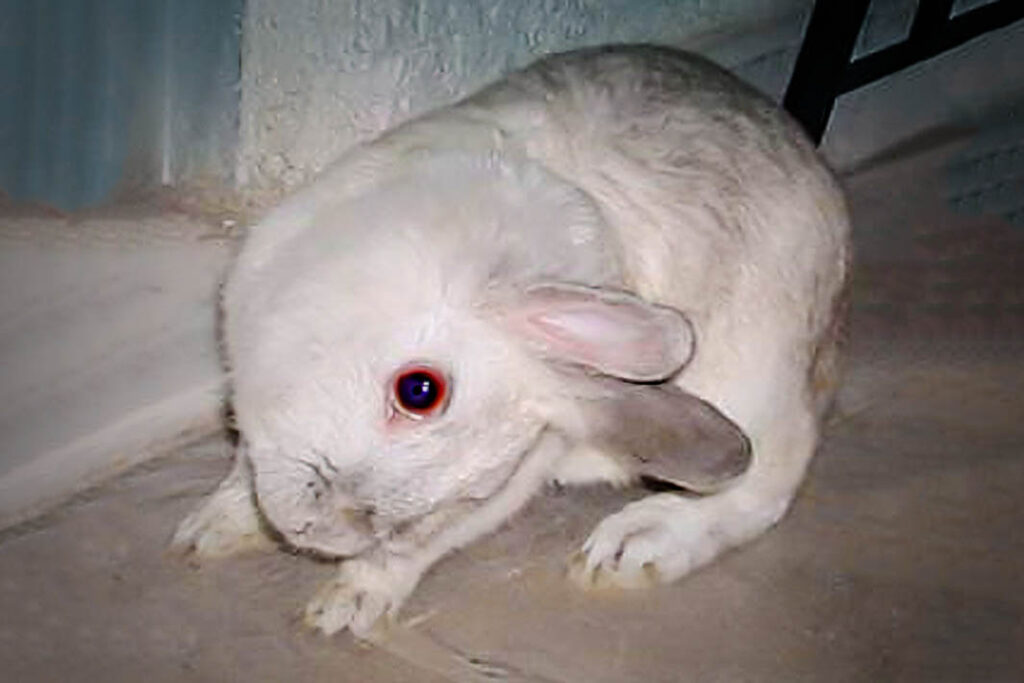
What is “head tilt?” The condition medically known as torticollis (Latin for “twisted neck”) and sometimes as “wryneck” makes a rabbit’s neck twist, causing the head to tilt sideways. Sometimes, torticollis is accompanied by nystagmus, a constant, involuntary movement of the eyeballs. The direction and nature of nystagmus can help your vet determine the cause of the torticollis in order to prescribe appropriate treatment.
Signs of torticollis may develop gradually or appear quite suddenly, but the result is the same: a bunny is walking around with her head on sideways. In severe cases, the bunny may be so disoriented that he simply cannot walk, and spends much of the time either lying on his side in apparent paralysis, or rolling in a wild attempt to regain footing. Of course, seeing a bunny in this condition is distressing to the human caregiver. But far too many a bunny suffering a treatable case of torticollis has succumbed to his caregivers’ well-meaning desire to “not let him suffer.”
In truth, head tilt is usually not only survivable, but treatable, though recovery may be gradual. Even a rabbit with a head tilt can live a happy, comfortable life as long as there is no pain, and the bunny enjoys eating, drinking, and being loved. I would consider euthanasia only as a last resort, if all attempts to treat the condition have failed, leaving the bunny in misery, unwilling to eat, drink or act normally at all. Remember that a permanently tilted head is not a symptom necessitating euthanasia! Many rabbits with their heads tilted at a jaunty angle are living completely happy lives, running and playing with all the vigor of their straight-headed bunny pals. The most important thing is to address the source of the head-tilt symptom. Once this is accomplished, improvement of the rabbit’s posture will usually follow gradually, with physical therapy and exercise.
It is not uncommon for torticollis to appear suddenly. As with almost any illness, the more rapidly the cause of the problem is diagnosed and treated, the greater the chance for full recovery. If you do not already have a good veterinarian who is experienced with rabbit medicine, please use the Rabbit.org Foundation’s Veterinarian Listings to find one in your area.
Causes of Torticollis
Torticollis is not a disease in and of itself. Rather, it is a sign of a problem with the rabbits’ balance system, components of which include the central nervous system (CNS, comprised of brain and spinal cord), the visual system, the vestibular apparatus in the inner ear, and even the pads of the feet, which tell the bunny he’s standing on terra firma. Thus, a rabbit exhibiting torticollis may have a problem with one or more of the balance components. Causes include (but are not limited to)
- middle- or inner-ear infection
- parasitic infection by Encephalitozoon cuniculi in the CNS
- parasitic infestation by the nematode (roundworm), Baylisascaris procyonis
- stroke
- abscess or tumor in the brain (i.e., intracranial abscess)
- head trauma
Successful treatment of the condition requires correct diagnosis of the problem’s ultimate cause.
Ear Infection
One of the most common reasons for torticollis in rabbits is infection of the middle- or inner ear. The vestibular system, largely responsible for the sense of balance, is located in the auditory bulla of the skull, a large, hollow space near the base of each ear. Infection in this area can cause inflammation and swelling of the soft tissues, and this can interfere with proper function of the vestibular apparatus. A very severe inner ear infection can actually cause the bulla to fill with hard, caseous (i.e., of a solid, cheeselike texture) pus.
Sometimes, pus is visible inside the ear, and the vet can take a sample for identification. This will reveal
- the type of bacteria most likely responsible for the infection
- the types of antibiotics most likely to kill the specific bacteria causing the infection
Although common pathogens associated with head tilt commonly include Pseudomonas aeruginosa and Pasteurella multocida, there are many others that also can cause ear infections or abscesses. Each species/strain of bacteria has characteristic sensitivity to certain antibiotics and and resistance to others. If possible, it is wise to identify bacteria so that the most effective antibiotic (or combination of antibiotics) can be administered.
Once the pathogen is identified, don’t be surprised if your vet proposes to try a combination of antibiotics to kill the bacteria. A combination of antibiotics is often more effective at resolving an infection than a single one. It is especially important that your veterinarian be familiar with the specific needs of rabbits in terms of antibiotics, since some them (e.g., any oral penicillins such as amoxycillin, and any lincosamine antibiotics such as clindamycin) can be deadly to rabbits, even if they can be used safely in other species.
Whatever the prescription, it is important to continue to administer the full dose for the full course your vet has prescribed, even if signs of disease improve. Stopping antibiotic therapy before an infection is fully controlled can select the most resistant bacteria, since they will be the last ones to die when exposed to antibiotics. If antibiotics are removed too soon, only the most resistant ones will be left to reproduce and repopulate your poor bunny’s head!
Unfortunately, ear infections and head abscesses, in general, can be difficult to treat. They tend to become “walled off” and are poorly supplied with blood vessels. This makes actually getting the antibiotic where it’s needed a challenge. The vet may choose an antibiotic that has better penetration of such difficult antibiotics.
One antibiotic therapy that has proven very effective in many difficult torticollis cases caused by middle- or inner-ear infection is dual-acting penicillin injections. This combination of Penicillin-G (benzylpenicillin) (often combined with procaine, a local anesthetic) and Benzathine penicillin has resolved abscesses in some of our rabbits who had previously been deemed terminal and untreatable. Pasteurella tends to be susceptible to penicillins, but if the abscess is caused by Pseudomonas (or other penicillin-resistant bacterium), then penicillins will not be effective. A different antibiotic must be chosen.
While the antibiotics are doing their work, your vet might also prescribe other drugs to help restore balance and control the discomfort associated with vertigo. Meclizine can be helpful for controlling dizziness, though it will not work for every rabbit. If meclizine does not control the vertigo and nystagmus, your vet might prescribe a course of short-acting corticosteroids to reduce the inflammation interfering with the vestibular apparatus. We have found that these drugs can sometimes help restore normal posture even before the infection is fully cured. However, corticosteroids should be used with great caution in rabbits, as they tend to be more prone to the adverse side effects of these hormones than many other species.
It can sometimes take weeks or even months to completely cure an inner/middle ear infection. This may sound like a long time, but if supportive care is offered, and the rabbit continues to eat and drink normally and is still interested in life, then he’s not ready to give up. The condition is disorienting, but does not seem to be painful. The illness is temporary, if hard to watch, but it’s worth a course of supportive care to see your bunny happy and running around again.
The results of patient nursing a bunny through torticollis can be very rewarding. I have nursed several rabbits through torticollis apparently due to ear infection/abscess.
- Slooby‘s head tilt appeared very suddenly. After only fourteen days on Baytril (enrofloxacin), he was completely upright, and the condition did not recur.
- Hamish and Jamie Blueboth had severe torticollis when they came to us as rescues, so we’re not sure about the onset of their signs.
- Hamish had a severe ear infection due to Pseudomonas aeruginosa sensitive to quinolone (e.g., enrofloxacin (Baytril), ciprofloxacin, marbofloxacin) and aminoglycoside (e.g., amikacin, gentamycin) antibiotics. He retained his tilt after the infection was resolved, but acupuncture, chiropractic treatments and massage helped immensely. Still, the single most important form of physical therapy–once he stopped rolling–was regular exercise in a spacious play area where he could run in wider and wider circles, working himself up to straight lines.
- Jamie Blue’s story is similar to Hamish’s: She was so disoriented that she could not stand, and spent most of her early days with us rolling in a padded pen. She had severe nystagmus. It took eight months on antibiotics to completely clear her ears of the Pseudomonas aeruginosa (which happened to be resistant to all the antibiotics tested except ciprofloxacin and colistin. Though she retained a slight tilt all her life, her head would go almost straight as she ran around looking at all the interesting things to see during supervised outdoor play time.
Encephalitozoon cuniculi
Although there is little conclusive evidence that this microsporidian parasite–related to coccidia and to the protists that cause malaria and other serious diseases–is truly a causative agent of torticollis, anecdotal reports and circumstantial evidence suggest that–if only in some immunocompromised rabbits–E. cuniculi can generate torticollis and other nervous system disorders (hind limb paresis, general weakness, seizures).
Mature E. cuniculi inhabit the central nervous system and renal (kidney) tissues of their definitive hosts, and infected rabbits showing signs of head tilt can also be suffering from renal compromise due to this parasite.
A number of articles on this putative pathogen can be accessed HERE.
At the moment, positive diagnosis of E. cuniculi infection can be made only upon necropsy, though histological results do not conclusively prove that the parasite was the cause of signs of illness.
A blood sample can be collected and sent to a laboratory to obtain a titer of E. cuniculi antibodies, produced by the rabbit in response to the presence of the parasite. However, a high titer does not necessarily indicate active disease; it says only that the rabbit has been exposed to the parasite at some time.
- A high titer may indicate that there is an active infection being battled by the immune system, or it could mean that the rabbit has the parasite under control.
- A low (or negative) titer may indicate little or no reaction to E. cuniculi, but this could mean either that the parasite is not present, or that the host’s immune system is not mounting a response.
Some vets will send two blood samples, taken a couple of weeks apart, for a paired titer. If the titer is rising, one interpretation is that there is an active infection and the bunny is mounting a defense. If the titer is falling, it could mean that the immune system is “standing down” after defeating an infection…or it could mean that the immune system is failing to respond to the parasite. Bottom line: Antibody titers are not necessarily the final answer for proper diagnosis. Because of this, many veterinarians will simply treat for E. cuniculi and hope for improvement of signs.
Benzimidazole drugs (e.g., oxibendazole, fenbendazole; [albendazole is NOT recommended, as it has been associated with acute death due to bone marrow damage in rabbits and other species]), readily cross the blood-brain barrier to inhibit the function of E. cuniculi’s tubulin, a protein essential for the parasite’s feeding and infection of new host cells. Suter, et al. (2001) reported that administration of 20mg/kg QD (once per day) of fenbendazole (which is metabolized to its active form, oxfendazole) was effective not only at preventing infection of rabbits by E. cuniculi, but also at eliminating signs of E. cuniculi infection in seropositive rabbits after four weeks of treatment.
Ponazuril is a drug developed for treatment of equine protozoal myeloencephalitis a horse disease caused by a parasite, Sarcocystis neurona, similar to E. cuniculi. Many veterinarians have been using this drug “off label” to treat E. cuniculi in rabbits, with anecdotal reports of success. I have been witness to one such case in our rescue bunny, Tilda. Tilda came to us with severe torticollis, but had no visible evidence of ear infection. We suspected that her tilt might be due to E. cuniculi. She was treated with fenbendazole and ponazuril concurrently for 30 days, and all traces of head tilt resolved completely, never to return.
Baylisascaris procyonis
Baylisascaris procyonis is a roundworm (Nematoda) that ordinarily inhabits the intestine of raccoons. However, if other species (including humans) ingest eggs transmitted by raccoon waste, there is a possibility of “wrong host” infection. The larval worms migrate, not to the intestine, but to the kidneys and central nervous system, causing life-threatening neurological problems.
At present, there is no treatment and no cure.
Physical Insult to the Central Nervous System
If head tilt is caused by a stroke or head trauma, the best one might hope to do is treat appropriately and hope for recovery over time. Treatment must be administered quickly at the onset of signs for best hope of a good prognosis.
If the problem is believed to be caused by an intracranial abscess, with no pus to culture, your vet might wish to try dual-acting penicillin (as described above). Intracranial abscesses are often associated with dental infections. Because these often are populated by normal inhabitants of the intestine, antibiotic treatment can be particularly troublesome. We have found that dual-acting penicillin can combat these pathogens without entering the intestine and causing potentially life-threatening dysbiosis associated with oral penicillins and lincosamine antibiotics.
The Benefits of Physical Therapy
Once medical treatments are starting to do their work, your bunny can benefit from regular exercise and physical therapy. Allowing the bunny to run in a very large area, where s/he can move in straight lines (not small circles) can make a significant difference, and speed healing.
Physical Therapist Larry Gavlak shares his hints for physical therapy that helped his bunny (Boper) regain his balance. Larry has used the same technique on humans who had lost their sense of balance, and he simply translated and scaled it for bunny!
Don’t Give Up
Many, many people have written to me, asking about head tilt. I’m happy to say that almost every one of them has written back to say that patience, loving husbandry and the proper medicine and physical therapy had their bunnies up and running again, even if it took weeks or even months. Everyone said it was worth the time and care.
Treatment of head tilt is not only possible, but often successful and rewarding. It might help to realize that rabbits do not mourn over what might have been, nor what the future might hold. If your rabbit is willing to survive the moment, is eating and drinking and showing affection and interest in life (however dizzily), s/he deserves a chance to heal. It is so rewarding to see a head tilt bunny race and frolic as before, even if it takes several months of treatment and love.
Literature Cited
Suter, C., U. U. Muller-Dobles, J. M. Hatt and P. Deplazes (2001). Prevention and treatment of Encephalitozoon cuniculi in rabbits with fenbendazole. Veterinary Record 148, 478-480.
Further Reading
- E cuniculi guide from WabbitWiki
- Tomás Rodrigues Magalhães et al. (2022). A multidisciplinary review about Encephalitozoon cuniculi in a One Health perspective
- University of Miami Miller School of Medicine. ECUN Serological Testing
- Frances Harcourt-Brown. (2005). Encephalitozoon Cuniculi in Pet Rabbits [PDF]
©Copyright Dana Krempels. All Rights Reserved. Republished with the permission of the author.